
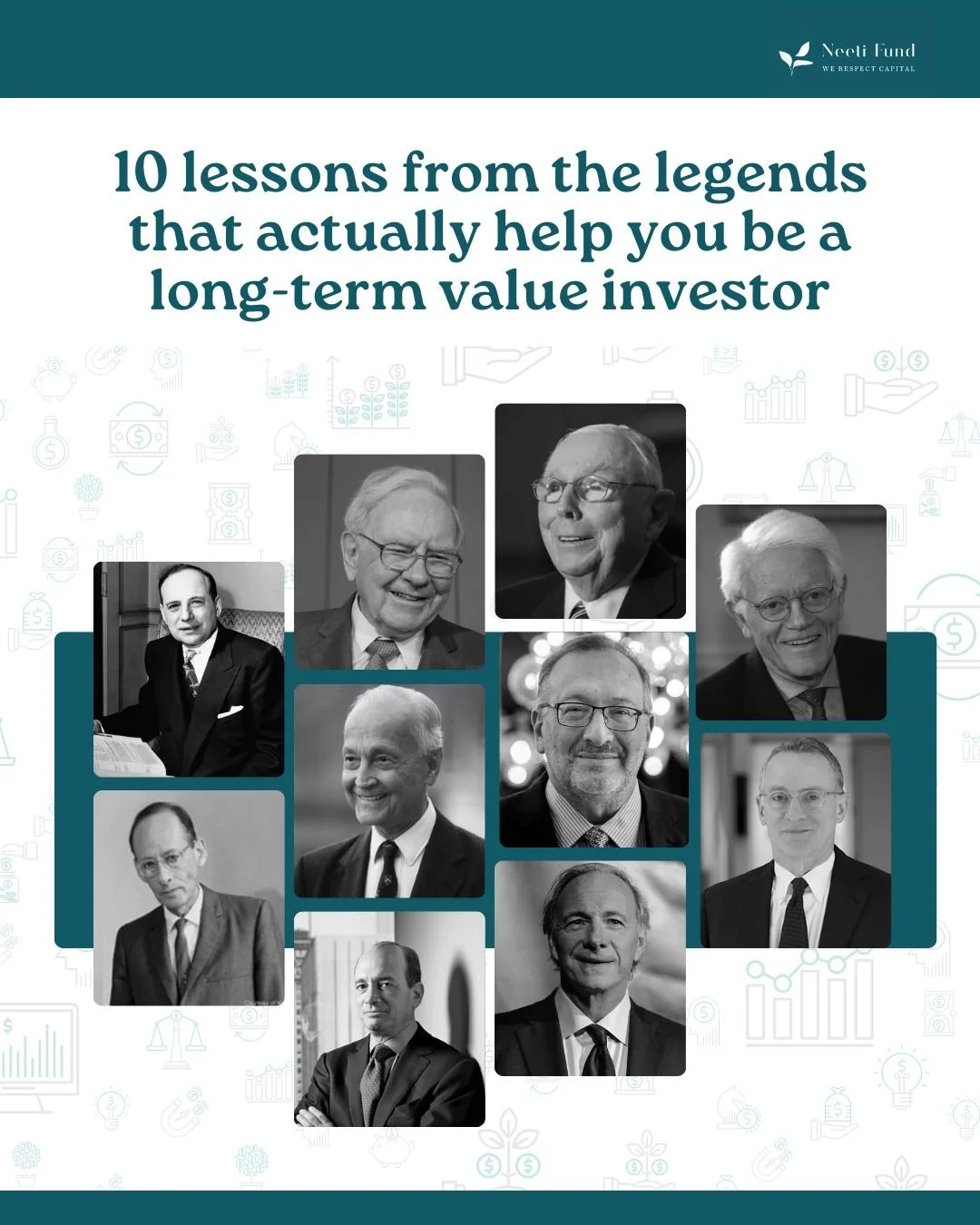
Most people “study” great investors.
Very few turn their ideas into a concrete operating system.
Here’s how I’d translate 10 legends into practical, long-term habits:
1. Benjamin Graham – Margin of safety
Before you buy, demand a clear discount to conservative intrinsic value.
No margin of safety means no trade.
2. Warren Buffett – Quality compounders
Prefer businesses with durable moats and high returns on capital.
Own them for years and let time do the heavy lifting.
3. Charlie Munger – Avoid stupidity
List the obvious ways an investment can fail.
If you cannot remove most of those risks with clarity, pass.
4. Peter Lynch – Circle of competence
Let daily life feed your ideas.
Start with what you truly understand, then do the work before you look at the chart.
5. Howard Marks – Respect the cycle
Stay long term, but flex exposure with the greed–fear balance.
Be less aggressive near euphoria and braver near despair.
6. Joel Greenblatt – High ROIC at fair prices
Hunt where return on capital is high and valuation is sensible.
“High ROIC + reasonable price” is a reliable fishing spot.
7. Seth Klarman – Capital preservation first
Begin with one question: how can I lose money here, permanently.
Sizing and selection follow from downside, not story.
8. John Templeton – Maximum pessimism
Maintain a watchlist in hated markets.
When sentiment is washed out and prices are unloved, begin real work.
9. Philip Fisher – Scuttlebutt over spreadsheets
Talk to customers, ex-employees, suppliers, and competitors.
Numbers confirm; people explain.
10. Ray Dalio – Systematize principles
Write rules for diversification, risk, and position sizing.
If it is not codified, it is mood, not method.